‘Norman Lindsay: Censored to Celebrated’ exhibition now open

Norman Lindsay (1879-1969) was one of Australia’s most prolific, praised and controversial artists. His bold, sensual works - rich with mythological symbolism and unapologetic eroticism - challenged the conservative values of early 20th-century Australia. At a time when moral censorship was widespread, Lindsay’s art was banned, burned, and fiercely debated. Yet his work was also deeply loved. His whimsical drawings of koalas and his enduring children’s classic, The Magic Pudding (1918), captured the imagination of generations.
The Library's Rare Books and Special Collections holds over 1,000 items related to Norman Lindsay, including original artworks, printing proofs, drafts, letters, and dedicated copies that offer rare insights into Lindsay’s creative process and personal connections. The collection also features more than 350 publications by Lindsay, hundreds of works he contributed to, and a vast reference archive celebrating his legacy, providing scholars and enthusiasts with a rich resource for research and discovery.
This exhibition, Norman Lindsay: Censored to Celebrated, invites viewers to consider both the censored and celebrated works of Norman Lindsay, exploring the breadth of his creative output. From public scandal to cultural icon, it reveals how his fearless imagination helped shape modern Australian identity.
_
Norman Lindsay: Censored to Celebrated
Rare Books and Special Collections Reading Room
Fisher Library, level 1
University of Sydney
Camperdown
On display until Thursday 26 March 2026
We welcome the public to view this exhibition. Please note that it is only open during Reading Room hours (Monday, Wednesday and Thursday, 10am-3pm; closed public holidays and University closedown periods). The Reading Room is a multiuse space for research, teaching and work.



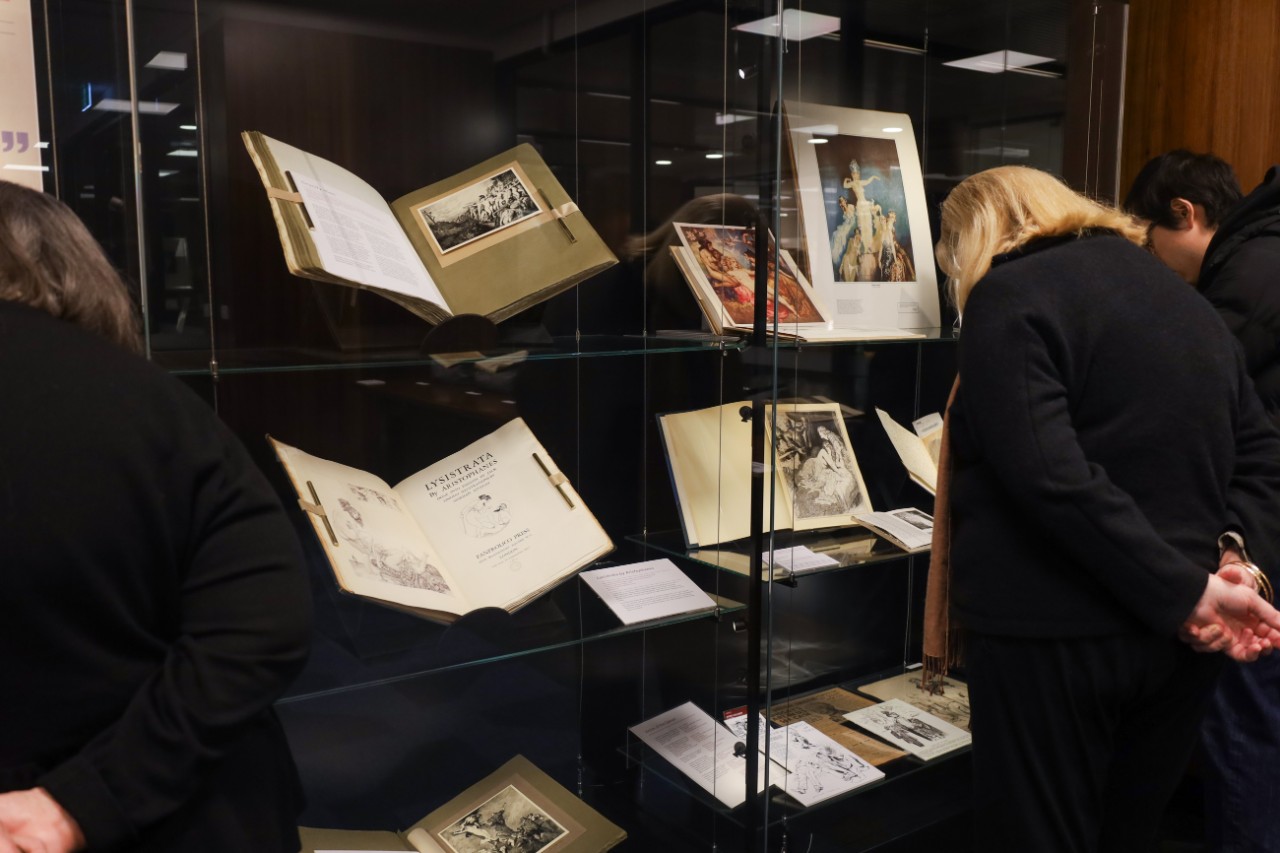
Norman Lindsay: Censored
“To Lindsay, life is a debauch, and the whole world a brothel”. Discontent (Brisbane), November 1925
Norman Lindsay’s first brush with public disapproval and censorious opinion occurred in 1903, when aged just 24, he exhibited with the Royal Art Society of NSW. Critically inflamed rhetoric juxtaposed with fulsome praise became the hallmark of Lindsay’s career. The following year another large pen and ink, Pollice Verso, raised an even greater furore for its perceived blasphemy. Lindsay however largely ignored these critics considering them “wowsers” - a contemporary term for puritans.
In August 1907, the newly formed Art Society in Sydney held its first exhibition, featuring 30 of Lindsay’s works. This display provoked one critic to exclaim Lindsay seemed “utterly unable to discern the difference between the nude and the naked” (Art & Architecture, 1907). In contrast, The Bulletin (1907) praised Lindsay as having “equalled the best black-and-white works in the world”.
Government censors intervened in 1923 as a major Australian art exhibition, featuring Lindsay’s work, was prepared for London’s Royal Academy. And public outcry reignited in 1924 when Australia’s contribution to the British Empire Exhibition also included his work. Critics including The Australian Women’s Christian Temperance Union, backed by a former Attorney General, led calls for a complete government boycott of his work.
In disgust, Norman Lindsay decided to leave the country and sailed to America, blasting wowsers, the government censors and Australia’s “stifling mediocrity”. He did however evenually return home to Springwood, now known as the Norman Lindsay Gallery & Museum in Faulconbridge.
Norman Lindsay: Celebrated
“Mr Lindsay has been through so many bursts of notoriety... that his works have boomed and bust as often as the national economy”. The Bulletin, 1964
Throughout his life Norman Lindsay’s name became a beacon for both criticism and admiration. No other Australian artist has ever attracted such prolonged and extreme praise and strident condemnation. In 1897, when Norman Lindsay was 18, The Clarion labelled him a “genius” and “the most powerful and original of the younger school of Australian artists”. This type of praise continued for the rest of his life, with critics around the world repeating the label.
Julian Ashton, was the first major Australian artist to bestow the ultimate praise of “genius” to Lindsay. A critic in The Labour Call (1907), described Lindsay as “audacious, defiant, pagan” and a “genius”. Two years later William Moore, Australia’s first major art historian, applauded Lindsay as “one of the few Australian artists to whom the term genius can be applied”. (Australia To-Day, 1910).
Praise followed Lindsay as he conquered the international stage. In 1923, London’s The Sketch gave its opinion, “[Lindsay’s] art suggests part genius, part the wilfulness of a deliberately naughty child.” America was equally captivated -The Nation (1930) described Redheap as the work of “a new writer, a genius”.
Norman’s celebrated status endured until his death in 1969, marked by The Mountain Gazette’s headline: “Genius Passes On”. A lifetime later, in 2021, The Australian celebrated the family legacy: “When it comes to high-achieving families, surely few could match the Lindsays”.

About the curators
This exhibition was curated by Robert Holden and Rodney Kent with Rare Books and Special Collections.
- Robert Holden is a retired Rare Books Librarian, art historian and the author of 40 books and countless articles, book reviews, conference papers and exhibition catalogues.
- Rodney Kent is a Sydney lawyer who has painstakingly assembled one of Australia’s premier private collections of works by Norman Lindsay. His collection ranges from original watercolours, etchings and illustrations to limited edition books and ephemera.
Together, the pair have devoted months documenting the unique Norman Lindsay holdings in the Library’s Rare Books and Special Collections as they compile an ambitious annotated bibliography of the artist’s work together with reviews and articles which document his controversial career.
About Rare Books and Special Collections
The University of Sydney Library holds one of Australia’s largest rare and special collections, with over 300,000 items. Highlights include medieval manuscripts and early printed books, as well as an extensive science fiction collection and East Asian collection.
Our wide range of Rare Books and Special Collections are available for University of Sydney academics and students to view, research and teach with. If you have an enquiry, please contact: cultural.collections@usyd.libanswers.com.
We also welcome the public to view and study our collections. You will need to register for a free Rare Books ID and visit during our Rare Books and Special Collections Reading Room opening hours. Find out more about viewing items from special collections.
If you are unable to visit our collections in-person, you can also book a Virtual Reading Room session, or explore thousands of digitised photos, illustrations, documents, magazines and more on our Digital Collections website and our Google Arts & Culture page.
Contact
For enquiries relating to Rare Books and Special Collections, please email: cultural.collections@usyd.libanswers.com.